03 - Reference gateway runtime layout
Status: Historical gateway design from a retired lab, not a current runtime layout or runnable acceptance fixture. The operator-reported architecture groups agent sandboxes into logical realms under an operator-core VM. Realm membership is not itself an isolation boundary.
The historical gateway design explored single runtime sources, independent lifecycle boundaries, and alignment checks. It does not describe live service units or current realm behavior.
Why the fixture existed
The legacy fixture modeled several agent profiles served by one template:
- one declared runtime source per profile;
- independent restart boundaries;
- separate profile homes and logs;
- dry-run alignment proof before a smoke test;
- no broad central dashboard mutation.
The design lessons remain useful, but the former per-profile gateway code has been retired. The current narrative discusses OpenShell sandboxes, operator-core VM governance, and separately scoped historical observations rather than a per-profile runtime map.
Reference fixture shape
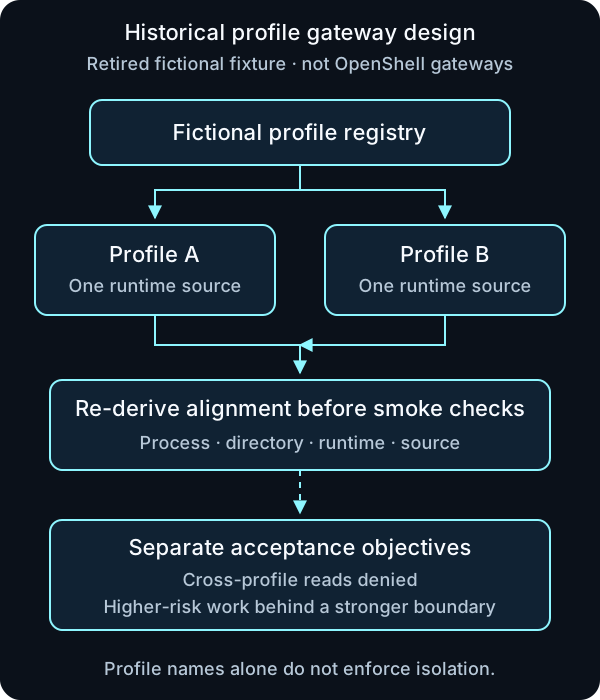
This diagram is a fictional reference fixture. It omits real service names, hostnames, ports, users, paths, and deployment details.
Lessons retained
| Lesson | Public-safe formulation |
|---|---|
| One runtime source | A workload should have one declared source of truth, not scattered environment overrides. |
| Independent lifecycle | Restarting or rolling back one profile/workload should not disturb unrelated profiles. |
| State isolation | Application-level state separation is not automatically a security boundary. |
| Alignment proof | Before a smoke test, re-derive what code/artifact is actually running. |
| Higher-risk work | Move untrusted or higher-blast-radius execution into a stronger boundary and record a receipt. |
Relationship to the reported case study
Use logical realms for workload grouping and individual sandboxes for the intended execution boundary. The historical profile gateway in this page is not an OpenShell gateway. Ansible configuration as code is one reported implementation choice, not proof that these retired fixtures still run, that grouping isolates workloads, or that recovery succeeded.
Non-claims
This page does not claim:
- that
agent-gateway@<profile>is the current public runtime stage; - that public docs reveal private service units, users, home paths, or ports;
- that application profile separation is sufficient as a security boundary;
- that a reference fixture is production-ready.