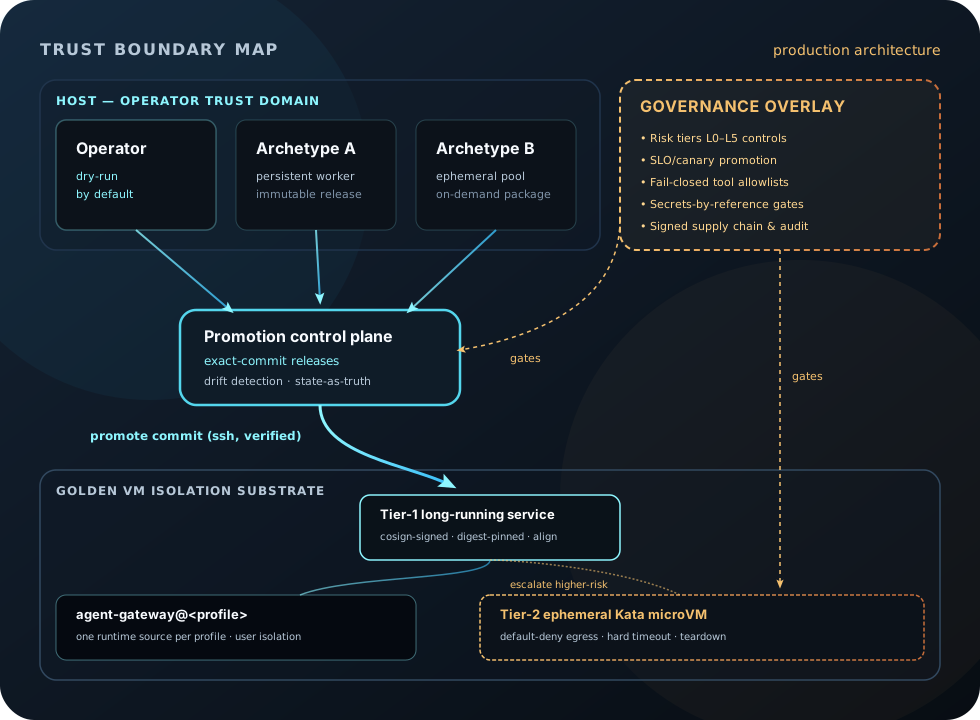
Map trust boundaries
Classify agent input, state, operator privileges, and external systems before choosing a runtime.
Vendor-neutral adoption framework · untrusted agents · evidence gates
BoundaryKit is a vendor-neutral framework informed by a running local implementation of agent sandboxes, using OpenShell and Ansible configuration as code. It turns that operational experience into a guide for choosing trust boundaries, limiting tools and data access, grouping workloads, and testing recovery. You can follow the method with other tools.
Identify higher-trust operators, execution boundaries, data paths, and the evidence needed for each claim.
Choose tools and egress per workload; require explicit approval and observable denials for unwanted paths.
Represent intended configuration as code, then test rollback and recovery rather than inferring proof from files.
what it is
Start with a trust-boundary map and tool inventory. Select an isolation substrate and policy for each workload, then group workloads for ownership and policy review. A logical group is not automatically a security boundary. Capture decisions, expected denials, and pass/fail evidence in the adoption guide.
The operator runs OpenShell agent sandboxes under an operator-core VM, organized into logical workload groups and managed with Ansible configuration as code. The diagram abstracts that operational setup. The separate fictional walkthrough teaches the method: its NOT RUN labels describe unexecuted example tests, not whether the real system is running.
adoption decisions
Classify agent input, state, operator privileges, and external systems before choosing a runtime.
Define allowed tools, secrets-by-reference, egress scope, and negative tests for each workload.
Separate ownership, policy, and state according to risk. Verify any claimed isolation; grouping is only organization.
Review configuration changes, collect scoped receipts, and require a rollback drill before promotion.
framework stages
Map untrusted inputs, execution, operator authority, state, and external connections.
Choose runtime controls by workload need, then test the intended allowed and denied paths.
Organize ownership, policy, and state; name the actual enforcement boundary separately from the group.
Review declarative intent, then observe rollback and recovery before making a promotion claim.
claim discipline
The adoption framework requires scoped tests and an observed recovery drill before promotion. Historical public receipts summarize earlier sandbox and inference-path attempts; neither measures current group-to-group isolation, proves present recovery, or certifies a new adopter's deployment.
Running locally · operator-confirmed experience
Historical · scoped boundary summaries
The local implementation is operational. The fictional walkthrough's unexecuted tests are separate; specific security and recovery claims remain tied to scoped evidence.
Read boundary receipt #1 → Read boundary receipt #2 →grounded in primary research
"Without network isolation, a compromised agent could exfiltrate sensitive files; without filesystem isolation, it could escape the sandbox."
Filesystem containment and default-deny egress are design objectives for sandboxed workloads, not evidence that the reported realms have passed independent isolation testing.
Anthropic Engineering (2025) →"By intercepting all sandboxed application system calls to the kernel, it protects the host from the application."
A sandbox implementation should treat tool actions as boundary-crossing events and retain host protection as a distinct design concern; this citation is not proof of any BoundaryKit deployment.
Google gVisor Platform →"A minimal device model that excludes all non-essential functionality and reduces the attack surface."
VM containment is a design backstop distinct from sandbox policy; this citation is not a measurement of the current operator-core VM.
AWS Firecracker microVM →illustrative workload categories
A long-running agent is one possible workload category. Its sandbox policy and state boundaries require workload-specific review, not an inference from realm grouping.
Short-lived processing is another possible category. No active lab, teardown validation, or live workload inventory is implied by this example.
adopt, then review the case study